Maximum yields call for both micro- and macronutrients to be available when and where a plant requires them. And, as one of eight essential micronutrients, boron is critical to reaching corn, soybean, and cereal crop yield potential.
Why boron?
Boron acts as a nutrient utilization catalyst by helping a plant to more efficiently metabolize nitrogen (N). Research also shows that boron plays an important role in rhizobial N fixation, actinomycete symbiosis, and cyanophyceae heterocyst formation in soybeans and other legumes.
Conversely, boron deficiency in corn and soybeans adversely impacts the metabolism and growth of the crop. Deficiencies impact cell-wall structure, inhibit root elongation, reduce plasm membrane stability, and a host of other metabolic functions within the plant.
Boron deficiency can cause significant yield loss in commodity crops, leading to fewer economic returns.
Causes of boron deficiency
Boron deficiency starts with the soil. Soils that have low concentrations of organic matter, are sandy, and are in areas with high rainfall will have low concentrations of boron. High soil pH will also reduce the availability of boron.
Boron deficiency symptoms in commodity crops
The signs of boron deficiency vary depending on the plant, but one element remains the same for all commodity crops—deficiencies appear on the youngest leaves first. This is because boron remains immobile in most commodity crops, resulting in stunted growth and poor development.
Corn
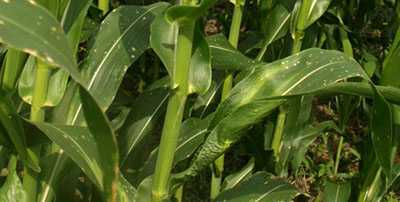
When boron levels are too low, the corn plant’s cell walls and stem cells disintegrate, preventing growth from the points of damage. Once cells have been damaged, plant growth is stunted, tassels fail to develop properly, and kernels do not set on the ear. Severe boron deficiency results in short bent ears of corn with under-developed tips and very poor kernel development. Yellow or white spots develop between the veins on young leaves, and the spots often combine forming streaks.
Soybeans
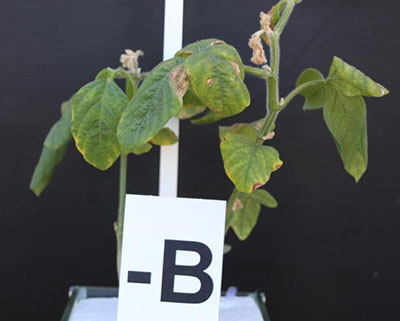
In soybeans, boron deficiency can present subtly while significantly diminishing a crop’s yield capacity. One marked symptom of boron deficiency in soybeans is delayed maturity and leaf senescence. The root tips die, and new roots are initiated giving a rosette appearance. Likewise, the death of the shoot growing point is followed by prolific development of lateral shoots with brittle petioles.
Optimal boron availability during soybean reproductive stages has been proven to:
- Stimulate root growth and nodule fixation
- Increase branching, flowering, bloom retention and number of pods
- Stimulate better seed development
Cereals
Small chlorotic spots form between the veins of the youngest unfolded leaves in cereal crops. The spots enlarge and coalesce to form the characteristic white stripes.
Test for success
Boron is not mobile in commodity crops, so soil and tissue tests are important to determine whether boron is at optimal levels in your crop. If you suspect that you have boron deficiency, it might be too late to make up the difference with additional fertilizer applications. If you find that your crop is indeed deficient in boron, taking steps to increase plant available boron is the first step to help prevent future problems.
- Soil testing is the best indicator of available boron in agricultural soils, however because of the volatility and mobility of boron within the soil profile, testing should be done strategically in proximity to the planting season of the cash crop being planted. Fertilizer applications should be calculated based on recent soil test results.
- Tissue tests should be run periodically throughout the growing season to provide the correct information needed to “spoon feed” the developing cash crop. Newly developed plant tissue should be sampled for corn and soybean crops.
How much boron is enough for commodity crops?
Boron is a micronutrient. As the name implies, you typically don’t need much to correct deficient soil.
- Solubor® is an excellent choice, allowing multiple foliar applications during critical reproductive stages, and can be combined with other applications of herbicide and insecticide. Solubor is cost effective and allows farmers to prepare his/her own tank mix.
- Granubor® is a good dry-application choice early in the season when you want to apply boron through the soil as a standalone application or in NPK blends. All boron in Granubor is plant-available and it allows for adequate availability of boron throughout the critical stages of the growing season.
Contact us
U.S. Borax agronomists and regional sales managers can help recommend products for your specific location and crop. Contact us today!
Resources