Boron Deficiency in FORAGE CROPS

Crops require adequate boron for nodulation and nitrogen fixation, as well as proper root growth. In clovers, boron deficiency typically shows up in stunted seed production, as this micronutrient is vital for proper pollen germination and pollen tube growth.

Alfalfa

Medicago sativa

Boron has been shown to increase yields and improve the quality of a wide variety of crops. Alfalfa, a common pasture crop, responds especially well to boron fertilizers.

Boron is an essential nutrient for all plants. Providing alfalfa with adequate boron is necessary for:

  • Greener, leafier plants with high protein
  • Faster regrowth after each cutting
  • Longer stand life
  • Improved winter hardiness
  • Enhanced root growth
  • Better water use, efficiency, and drought tolerance
  • Increased root nodule development for fixing nitrogen
  • Thicker stands to suppress weed and grass growth

Boron deficiency in alfalfa, in its mildest form, can easily pass unrecognized—it appears as a reduction in flowering and seed set. Such a mild boron deficiency is seldom detectable in hay yields from a single cutting. However, reduced flowering may delay cutting, and the result is a poorer quality hay. Eventually, the total quantity of this pasture crop may be reduced.

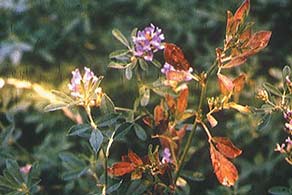
The main symptoms of boron deficiency are yellowing and reddening of the upper leaves. As the deficiency develops, the top stems progressively shorten and the short side branches give the plant a “rosetted” appearance. At this stage, the growing point becomes dormant or dies.

Boron deficiency is closely associated with moisture stress and drought. Alfalfa yellowing caused by boron deficiency is frequently mistaken for drought damage. Flowering is often reduced and the flowers fall before setting seed. Boron deficiency symptoms look different than leaf hopper injury, potassium deficiency, and certain diseases, all of which cause yellowing of both the lower and upper leaves. With boron deficiency, the yellowing is confined to the upper leaves; it does not occur randomly, as is the case with leaf hopper injury.

Alfalfa resources

Spotting boron deficiency in Alfalfas

Yellowing and reddening of alfalfa leaves, resembling drought symptoms, can be a sign of too little boron.

Bermudagrass

Cynodon dactylon

Bermudagrass requires a high fertility soil for optimum production. Well-drained soils with a good supply of nutrients is key to set the potential high forage yields. Additionally, it is recommended to correct the soil pH to around 6 to optimize nutrient uptake by the root system.

Bermudagrass is not very sensitive to boron-deficiency. However as with any other plant, bermudagrass requires an adequate supply of boron to reach its yield potential. The most common symptom of possible deficiency is decreased forage yields, especially during late spring and early summer cuttings when weather conditions are hot and dry.

The critical level of hot-water-soluble boron for bermudagrass in most soils is not well established but it ranges between 0.1-0.4 ppm, depending on the soil pH, organic matter content, and texture. Bermudagrass grown on soils below the critical level may respond to boron application, depending on the variety and the weather conditions during the growing season. If boron levels are above 0.4 ppm, boron applications may not influence yield.

When applying a foliar application in the recommended amounts, a small fraction of the actual boron will be absorbed through the plant tissue. Most boron will be absorbed via the roots.

Agronomy note: Boron applications for bermudagrass


Buffel grass

Cenchrus ciliaris

Boron deficiency in buffel grass typically has the following symptoms:

  • Newly emerging leaves fail to unroll
  • Leaves remain white, wither, and then die back from the tip
  • Tips of older leaves may also die back
  • Leaf margins may crack and white streaks, which coalesce, often develop between the veins
  • Plants are likely to be stunted but no reduction in tillering is expected

Clovers

Trifolium

Clover crops require adequate boron for nodulation and nitrogen fixation, as well as proper root growth. Clover seed production appears to be particularly sensitive to boron deficiency. Crops that do not show any obvious symptoms or whose growth is only slightly improved by boron applications can respond dramatically to boron applications in the seed production year.

Boron is needed for proper pollen germination and for pollen tube growth. There is also evidence that increased nectar secretion (and possibly flower modification) brought about by boron application can increase the numbers of bees working over clover flowers and thereby improve seed set.

Different clover varieties exhibit different boron deficiency symptoms.

Alsike clover

Trifolium hybridum

The main symptoms of boron deficiency in alsike clover include:

  • Stunted plants
  • Leaflets with interveinal yellowing and a bronzed appearance with the veins remaining dark green
  • Malformed leaves at the shoot tips
  • Short flower stems with few flower heads

In addition, plants may have poor pollen germination and tube growth when either pollen or pistil is boron deficient.

Burr clover

Medicago hispida

When burr clover is boron deficient, the plants are much reduced in size. In addition, the young leaves near the growing points are twisted, thickened and curled at the leaf margins.

Crimson clover

Trifolium incarnatum

Together with alfalfa and berseem clover (T. alexandrinum), crimson clover is rated as being very sensitive to boron deficiency. The symptoms of boron deficiency are very similar to those reported in other clovers, namely stunting and eventual malformation of young leaves and shoots, with red and yellow tints developing on leaves.

Red clover

Trifolium pratense

If boron deficiency occurs on very young red clover seedlings, the first trifoliate leaf will be small and imperfectly shaped. Young leaves will be small and distorted, and eventually the growing points die. The leaves develop red and purple tints (sometimes following a general chlorosis). The colors are usually more pronounced on the under surface of the leaf. Leaf margins may become necrotic.

Red tints may develop on older unifoliate leaves. On older plants, growth will gradually become stunted with the stems often swollen and thickened near the growing points.

Subterranean clover

Trifolium subterraneum

Boron deficiency symptoms in subterranean clover first appear on the young leaves, which are chlorotic, stunted, and distorted. The older leaves usually show some intense purple or red pigmentation along the margins.

Stem growth is reduced. Seed set and quality may be impaired leading to poor regeneration.

Sweet clover

Melilotus spp.

Sweet clover leaves turn red and later yellow when the plant is deficient in boron. Growth is also slow and stunted.

White clover

Trifolium repens

Boron deficiency symptoms in white cloverIf boron deficiency occurs on very young white clover seedlings, the first trifoliate leaf is small and imperfectly shaped. Red tints may develop on older, unifoliate leaves.

On older plants, growth will gradually become stunted with the stems often swollen and thickened near the growing points. Young leaves are small and distorted, and eventually the growing points die. The leaves develop red and purple tints (sometimes following a general chlorosis). The colors are usually more pronounced on the under-surface of the leaf.

Finally, leaf margins may become necrotic.


Kale

Brassica oleracea var. acephala

The leaves of boron deficient kale are curled, rolled, and somewhat chlorotic or mottled, particularly around the leaf margins. The growing point dies in cases of severe deficiency and is replaced by lateral shoots. Brown and water-soaked areas may appear in the pith of the stem which may also be hollow.

Typical recommended ranges for boron boradcast soil application for kale is 2-3 lbs of B/acre. Normal plant analysis levels for the best quality and marketability have leaf boron levels in the 30-60 ppm range.*


*Always consult local crop advisors to check the proper dose rates. Rates of boron fertilization should be based on yield goals along with soil tests and/or plant tissue analyses.


Leguminous crops

Apart from the normal boron requirement for growth and development, these plants have a special boron requirement for nodulation and nitrogen fixation, both of which are normally impaired in boron-deficient plants. As in most plants, boron deficiency has a marked effect on root growth and this in itself is likely to reduce nodulation.


Leucaena leucocephala

When Leucaena leucocephala is boron deficient, the plant's growing points become malformed and the young leaves are thick and dark green. The rachis bends downwards. The pinnules are narrow and of unequal size. Expect some axillary development. Roots are:

  • Dark in color
  • Stunted
  • Show little branching

Lotononis bainesii

The primary symptoms of boron deficiency in Lotononis bainesii include:

  • Thick and dark green young leaves
  • Misshapen and unevenly sized lateral leaflets
  • Leaflets curling backwards
  • In older leaves, some veinal chlorosis can occur followed by loss of turgor

In addition, many new but malformed shoots are likely to form. Leaves may show red pigmentation around the leaf margin. And, root growth is stunted with the roots thick and dark in color.


Mustard

Sinapis alba

Boron deficient mustard plants are dwarfed and have rough leaves that roll downwards from the tip. Other symptoms may include:

  • Leaves with a marginal yellowing that sometimes develops over the entire leaf surface
  • Reduced flowering stalks
  • Sudden petal fall
  • Lateral shoot development from the older leaf axis

Caring for cabbages, canola, and other brassica crops


Neonotonia wightii

Neonotonia wightii

In the early stages, of boron deficiency in Neonotonia wightii, leaves and shoots are dark green. The leaves are thick and narrow and may be malformed, with the two lateral leaflets being of unequal size and shape.

When boron deficiency is severe, the shoot tip becomes necrotic and secondary growth is initiated. In older plants, a mild deficiency is manifested by yellow and orange tints in the upper leaves. Root growth is reduced, there is little branching, and the root tips are brown and bulbous.


Panicum

Panicum maximum

Boron deficiency symptoms in panicum include:

  • Growing points die, causing stunting and excessive tillering
  • Leaves are short and dark green
  • White streaks develop near leaf margin parallel with veins

Paspalum

Paspulum dilatatum

White streaks develop on the youngest leaves of boron deficient paspalum plants. The leaf margins tend to roll inward and the leaf blades are stunted. Ultimately, the growing points die and there is an increase in tillering.


Perennial African grass

Setaria sphacelata

The short internodes and leaf sheaths on boron deficient perennial African grass result in a cluster of leaves at the top of each tiller. The growing points on some tillers of each plant die. Where ears develop, they usually fail to emerge completely.


Phaseolus atropurpureus

Phaseolus atropurpureus

Symptoms of boron deficiency in Phaseolus atropurpureus first appear on the youngest leaves, which will be:

  • Dark green
  • Thick
  • Turgid
  • Brittle

New secondary growths are also likely to be affected. Roots will be brown and tips swollen.


Rhodes grass

Chloris gayana

Boron deficiency in young leaves of rhodes grass typically includes the following symptoms:

  • White streaks develop between the veins, particularly near the leaf margins
  • Leaves tend to roll inwards

As the deficiency becomes more severe, larger and more numerous white areas develop, and the new leaves wither and die shortly after emergence. There is an increased tillering, and death of some of the growing points can be expected.


Townsville stylo

Stylosanthes humilis

Boron deficient plants are prostrate and have thick dark green stems and short internodes. The young leaves may have an irregular interveinal chlorosis and show some red and yellow tints.

Emerging leaves and recently expanded leaves are often nearly normal in color but will be distorted, with unevenly sized leaflets.


Trefoil

Lotus corniculatus

Boron deficiency symptoms in trefoil are very similar to those described for T. repens (white clover) and T. pratense (red clover).

U.S. Borax products for forage crops

15% Boron |  | OMRI Certified
Fertibor
Optimum product for suspensions

A fine crystalline borate ideal for NPK compound fertilizers and suspensions. Manufactured as free-flowing granules, Fertibor is easily handled and offers superior flow and consistency.

Learn more →

15% Boron |  | OMRI Certified
Granubor
Made especially for bulk blenders

A pure, 100% water-soluble micronutrient that meets boron demand during the growing season. Made especially for bulk blenders, Granubor helps to ensure uniform distribution in nutritional blends and in the field.

Learn more →

20.5% Boron |  | OMRI Certified
Solubor
Product of choice for foliar applications

A concentrated, highly soluble, and fast dissolving powder that is ideal for foliar and other sprays. With the highest concentration of boron in any approved product, Solubor is an economical choice for nutritional formulations.

Learn more →

11% Boron (w/w)
Liquibor
Liquid boron from boric acid

The convenience of liquid boron fertilizer straight to your farm with no measuring or mixing required.

Learn more →


10% Boron |  | OMRI Certified
Solubor Flow
For fertigation or hydroponic growing

First and only aqueous suspension of sodium borate microcrystals.

Learn more →

14.5% Boron | 29% Zinc
Zincubor
Perfect combination of zinc and boron

Because zinc and boron deficiency are widespread around the world, a product with both nutrients is a good fit in many regions. Zincubor brings these two important micronutrients together in one product.

Learn more →

U.S. Borax, part of Rio Tinto, is a global leader in the supply and science of borates—naturally-occurring minerals containing boron and other elements. We are 1,000 people serving our customers with more than 1,200 delivery locations globally. We supply around 30% of the world’s need for refined borates from our world-class mine in Boron, California, about 100 miles northeast of Los Angeles.

Copyright © 2026 Rio Tinto. All Rights Reserved.
Terms and conditions Privacy and cookies Modern slavery statement
AB 1305 Cookie preferences